RAVE: The Full-Stack Rust Template That Respects Your TypeScript
Rust backend, TypeScript frontend, one binary, zero friction
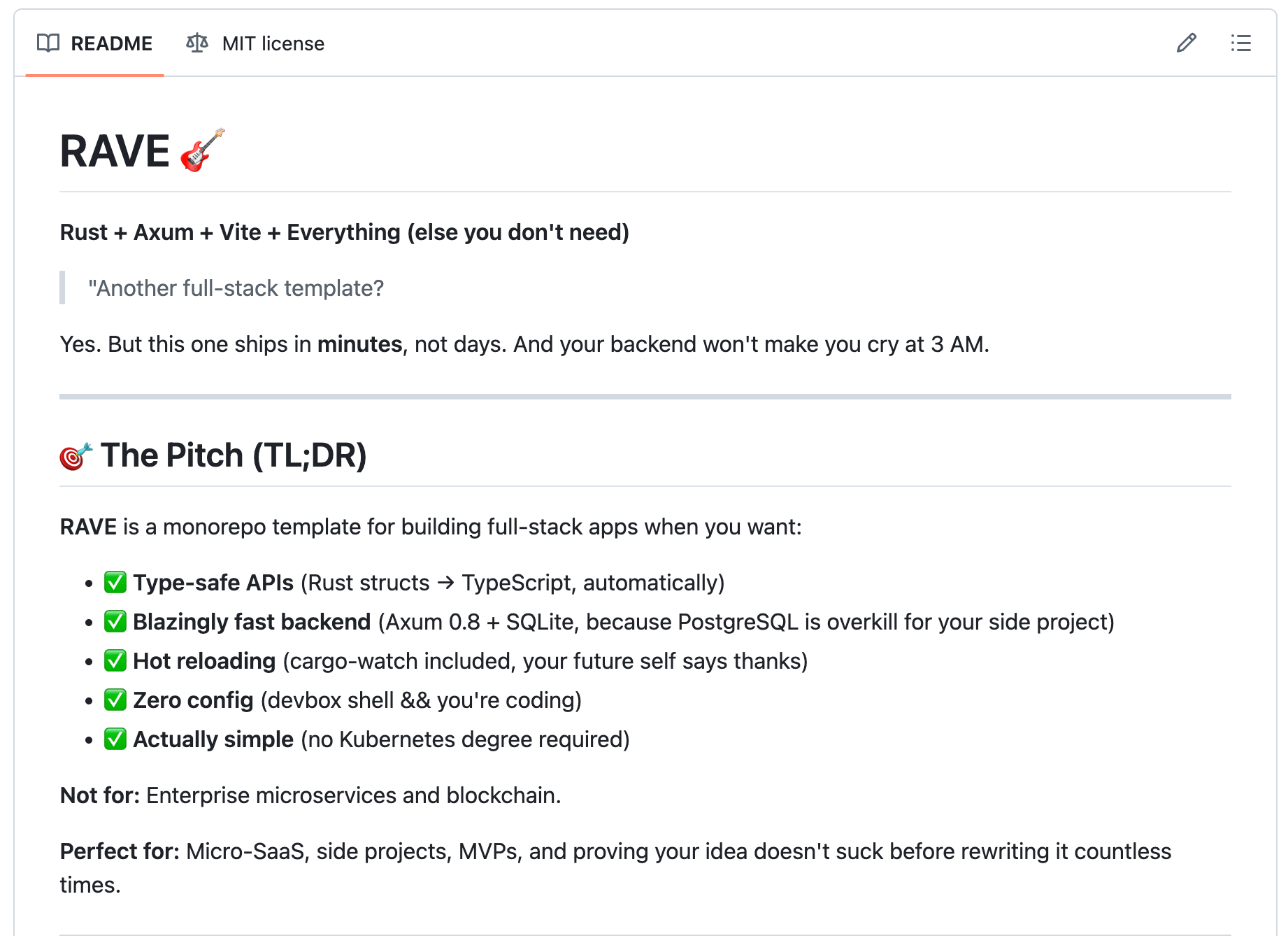
RAVE is Rust + Axum + Vite + Everything else you don’t need. It’s a full-stack template where the backend writes your TypeScript types for you — then serves both API and frontend from a single binary.
git clone https://github.com/DnzzL/rave-template.git
cd rave-template && devbox shell
devbox run dev:examples:todo:backend:watch   # Rust hot-reloads
devbox run dev:examples:todo:frontend        # Vite dev server
No Docker. No Nginx. No Kubernetes degree required.
What Makes RAVE Different from Other Rust Starters
The Rust full-stack ecosystem has options, but they all make you compromise.
| RAVE | Tauri | Leptos / Yew | Axum + manual setup | |
|---|---|---|---|---|
| Frontend | Your framework (React, Vue, etc.) | Webview (no real browser) | Rust WASM (new framework) | Your framework |
| Type safety | Auto-generated (ts-rs) | Manual IPC types | Rust-only | Manual sync |
| Deployment | Single binary | Native binary | WASM + separate backend | Binary + static files |
| Learning curve | Know TypeScript? You’re ready | Need Tauri + Rust knowledge | Need a new frontend paradigm | Need to wire everything up |
| CORS | None (same-origin) | None (native) | Needs proxy | Needs proxy or CORS config |
Every other Rust starter forces you to either learn a new frontend framework (Leptos, Yew, Dioxus) or deal with CORS, proxy configs, and manual type syncing.
RAVE lets you keep your existing TypeScript skills — React, Vue, Svelte, whatever — and get Rust on the backend without the integration headaches.
The “Wow” Demo: Your Types, Automatically
This is the part that made me stop and smile when I first got it working.
Define your model in Rust once:
// backend/src/models.rs
#[derive(TS, Serialize, Deserialize, sqlx::FromRow)]
#[ts(export, export_to = "../../frontend/src/bindings/")]
pub struct Todo {
    pub id: i64,
    pub title: String,
    pub completed: bool,
    pub created_at: chrono::DateTime<chrono::Utc>,
}
Run cargo test, and your frontend has perfect types:
// frontend/src/bindings/models.ts — auto-generated, never touch this file
export interface Todo {
  id: number;
  title: string;
  completed: boolean;
  created_at: string;
}
Use them with full type safety:
async function getTodos(): Promise<Todo[]> {
  const res = await fetch('/api/todos');
  return res.json(); // ← Fully typed. No `any`. No manual d.ts files.
}
Your backend is the source of truth for types. No more “let me check what the API returns” or keeping a Postman collection alive. Change a field in Rust, re-run tests, and your frontend instantly knows about it. TypeScript catches mismatches at compile time, not runtime.
Same-Origin Deployment: Why CORS Is Someone Else’s Problem
Most full-stack setups serve frontend and backend on different ports/domains → CORS headers → preflight requests → “why isn’t this working in production?” head-scratches.
RAVE serves the frontend/dist/ folder as static files from the Axum binary. Your API lives at /api/, your frontend at /. Same origin, no CORS, no proxy config in production.
cd frontend && npm run build
cd backend && cargo build --release

# Deploy to any VPS
scp target/release/rave-backend your-server:/app/
scp -r frontend/dist your-server:/app/
DATABASE_URL=sqlite:./app.db ./rave-backend

# That's it. Your app is live.
What’s Not Included (And Why That’s The Point)
- ❌ Kubernetes — You don’t need it for a side project
- ❌ Message queues — Add them when you have a queue problem
- ❌ Microservices — You definitely don’t need it yet
- ❌ Complex auth — There’s an
AUTH.mdfor when you do - ❌ GraphQL — REST with compile-time checked queries works fine
The template ships the absolute minimum to be productive immediately:
- SQLite with WAL mode (99% of projects don’t need PostgreSQL)
cargo-watchfor instant server restarts on.rschangesdevboxfor reproducible environments- API response standardization
- TypeScript proxy setup in Vite for development
Who RAVE Is For
You should use RAVE if:
- You want Rust on the backend without giving up your TypeScript frontend
- You’re tired of manually syncing API types between frontend and backend
- You want deployment to be
scp+run— no Dockerfile, no CI pipeline - You want to build side projects that could actually scale if they take off
You should NOT use RAVE if:
- You need to learn a new frontend paradigm (go use Leptos/Yew)
- You’re building the next Facebook (hire a DevOps team)
- You hate compile times (Rust compiles slower than TS, that’s life)
- You need PostgreSQL today (swap the SQLite URL, the rest works)
The RAVE Promise
I built RAVE because I wanted Rust on the backend without the usual friction. The type safety, the same-origin deployment, the cargo test → types pipeline — these aren’t gimmicks. They solve real problems I hit when I tried to use other Rust stacks.
If you know TypeScript and want Rust on the server, RAVE is the shortest path there.
Check out the full documentation including the auth guide in AUTH.md.
RAVE: Rust backend, TypeScript frontend, one binary, zero friction.